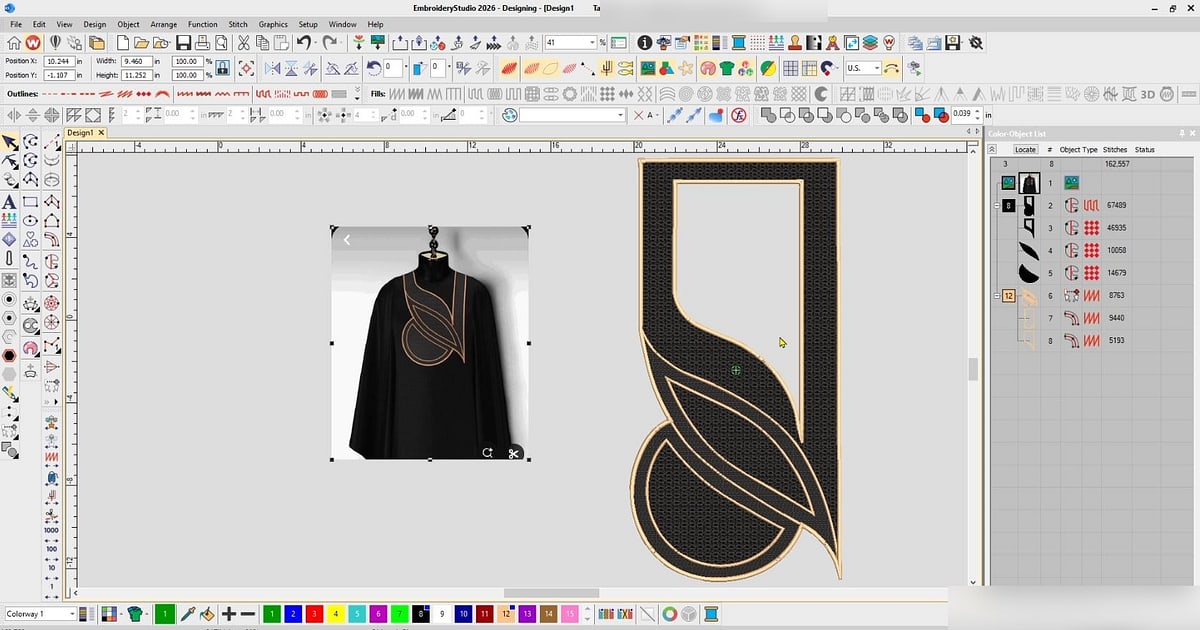
A left-chest badge is under 10,000 stitches. The agbada motif on this page is 162,557. Here's what changes when a design covers a garment panel instead of a pocket.

Most digitizing advice you will read was written for a left-chest logo on a cotton polo. It's not wrong, it's just describing a different job.
The motif on this page is 162,557 stitches across roughly nine and a half by eleven inches. A club badge, by comparison, is under ten thousand. That's not the same work scaled up. Almost every decision changes.
Here's what native wear actually demands, and why it's the part of this trade that doesn't travel.
Three real jobs, read off the object lists:
At production speeds that last one is several hours on a single head, for one garment. That means two things immediately. Machine time has to be in your price, not just the file. And every inefficiency in the design gets multiplied by hours rather than minutes, so a sloppy sequence that costs a badge thirty seconds costs an agbada far more.
A logo sits inside a small area of stable fabric with the rest of the shirt anchoring it. A native wear motif runs across a whole panel, often down a placket, sometimes around a neckline that curves.
Two consequences. Distortion accumulates: as thread goes down, the fabric moves, and the further the design travels the more that movement compounds. And hooping stops being trivial. You are handling a large piece of cloth, sometimes already made up, and getting it firm without stretching it is half the job.
The design has to be sequenced with that in mind, working so the fabric is not dragged across areas already stitched. On a left chest you can get away with almost any order. Here you can't.
Native wear fabrics vary enormously and few of them are as forgiving as a polo. Many move. Some are fine and slippery. Some are heavy and textured. Guinea brocade, lace, aso oke and the various shiny synthetics all behave differently under a needle.
So the same motif genuinely needs different settings per cloth, and testing isn't optional. The way to build knowledge here is one design, one change at a time, written down, as our guide to stitch types for different fabrics sets out.
This is what separates good native wear from acceptable native wear.
Motifs are frequently mirrored: down both sides of a placket, across a chest, around a neckline. The human eye is remarkably good at spotting when two things that should match do not, and a two millimeter difference between the left and right side of a chest panel gets noticed by the person wearing it even if they can't say why.
So placement and alignment need planning before stitching, and repeated elements need to be genuinely identical rather than redrawn by hand each time. Where a garment is stitched in more than one hooping, registration between hoopings becomes the thing that decides whether the piece is sellable.
Worth its own section, because it's the part that ruins finished garments rather than test pieces.
On a polo you hoop a flat area and get on with it. Here you may be handling a made-up garment, or a panel of expensive cloth, and getting it firm without stretching it is a skill in itself. Stretched fabric springs back when it comes out of the frame and takes the design with it, so a motif that looked square in the hoop finishes slightly pulled.
Where a design needs more than one hooping, the registration between them decides whether the piece is sellable. Mark your positions, work from a consistent reference on the garment rather than from the previous stitching, and check alignment before committing rather than after.
And practice on offcuts. A ruined test square costs nothing. A ruined length of brocade costs whatever the client paid for it.
A great deal of this work is one shade on a similar shade. Gold on black, white on cream, navy on navy.
That changes what carries the design. With a corporate logo, color contrast does most of the work. Here the design reads through texture, stitch direction and the way light catches a satin column, because there is very little color difference doing the job.
Which makes stitch direction a design decision rather than a technical one. Two adjacent areas of the same thread laid at different angles will read as different tones, and that is often the only thing separating one element from the next. Lay everything in the same direction on a tone-on-tone piece and it flattens into a single mass.
The temptation on large areas is to cover heavily. Resist it.
A chest panel stitched too densely becomes a board. It doesn't drape, it creases badly, and on a garment somebody is going to wear to an event for six hours, that matters more than it does on a work polo. Heavy coverage also stiffens the fabric enough to change how the whole garment hangs.
The usual answer is to let the fabric participate. Open motif work, outlines with texture inside, colored cloth showing through as part of the design. That's both lighter on the machine and better looking than filling everything solid.
Worth being blunt about, because it explains the whole market.
A digitizer in another country can produce a corporate logo perfectly well. They can't easily produce good native wear, because they've never handled the fabrics, don't know how the garments are constructed, and haven't seen what customers here expect a finished agbada to look like. That knowledge comes from the workshop floor, not from software.
That's why this is protected work, and why it pays. It's also why anyone building an embroidery business here should be moving towards it rather than competing on left-chest logos with the whole internet.
Native wear pricing goes wrong when people quote it like logo work.
The file is one line. The machine time is hours per garment. The hooping is skilled handling of expensive cloth, where a mistake ruins the garment rather than a test piece. The testing is on fabric that costs real money. All four belong in the quote.
Our guide to how many stitches a design should have shows how to turn a count into machine minutes, which is the number that should be driving the price.
Native wear is the last thing to learn, not the first. The order that works is lettering, then simple logos, then caps, then this, because every skill it needs is one of the earlier ones under harder conditions.
It's also the reason the course exists. Our Digitizing Mastery course goes through to agbada and kaftan work specifically, which almost no training covers, because most training was written somewhere that has never stitched one. If you are starting further back, our guide to becoming a professional embroidery digitizer lays out the order.
And for motifs you do not need to design from scratch, EmbGig carries machine-ready native wear files from digitizers who work in these fabrics.
Hours rather than minutes. A set running into six figures of stitches will occupy a single-head machine for most of a working session, which is why production planning matters as much as the digitizing.
Not from a stitch file, and not by much even from the source. These designs are built for a specific panel, and scaling changes density across very large areas where it shows immediately.
Hooping and symmetry, ahead of the digitizing itself. The file can be excellent and the piece still be wrong if the two sides do not match or the fabric was stretched in the frame.
Yes, and the corporate work is the reason. Logo digitizing is competing with everyone online, and prices reflect that. Native wear is competing with whoever else in your city can actually do it, which is a much shorter list.
You need enough embroidery area for the panels you want to take on, which is the specification worth checking before buying. Our guide to choosing the right embroidery machine covers it.
Native wear is the same craft under harder conditions: six-figure stitch counts, fabric that moves, symmetry nobody forgives, and tone-on-tone designs that read through direction rather than color. It's slower, it's riskier, and it's the work that can't be sent abroad, which is exactly why it is worth learning.
The Academy turns articles like this into proper courses, with video lessons, assessments, and people to learn alongside.