After sixteen years digitizing, here's my honest answer on whether AI is coming for embroidery digitizers, which jobs it's already taking, and which ones it can't touch.

Every few months someone asks me if AI is about to make embroidery digitizers obsolete. I've been digitizing for over sixteen years, so here's my honest answer, the good and the bad.
The short version: no, and the reason has nothing to do with loyalty to the craft. It's that embroidery happens on fabric, and fabric is the part software still can't see.
Auto-digitizing has been around far longer than the current AI hype. Point it at a simple, clean shape, a basic outline or a solid block, and it can produce a usable file in seconds. The newer AI tools are better at cleaning up blurry artwork and tracing simple logos than the old auto-digitize button ever was. For the simplest jobs, it genuinely helps.
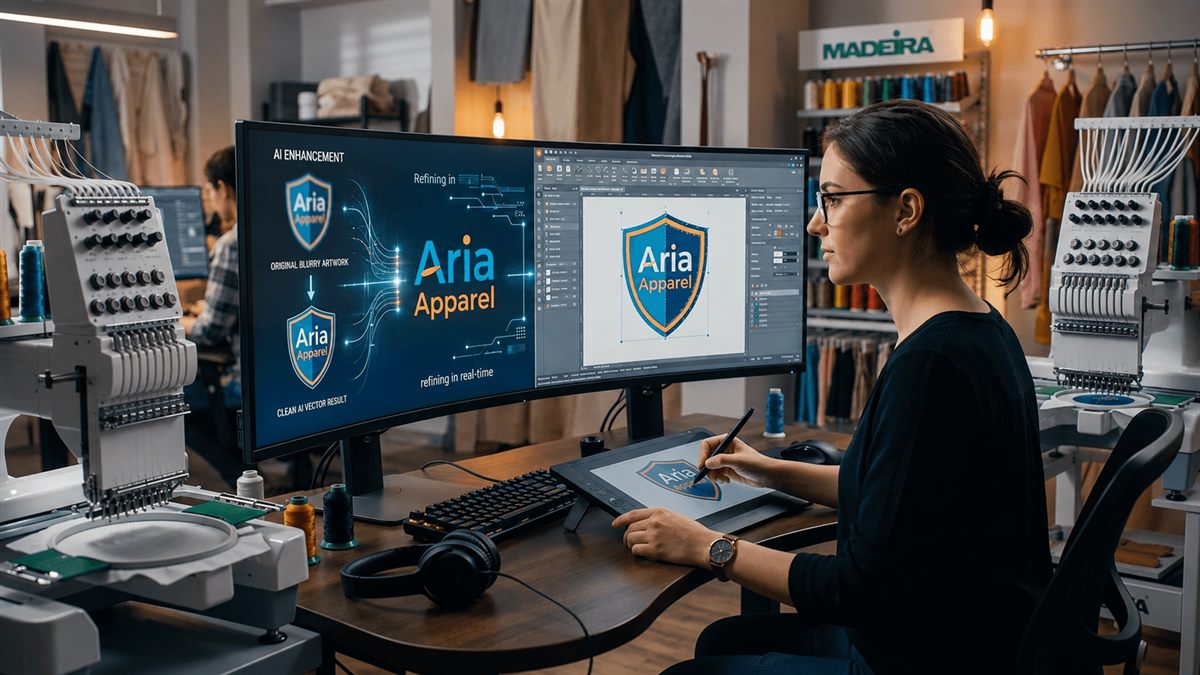
It's also quietly useful before the digitizing starts. Sharpening a logo a client photographed off a signboard, knocking out a background, redrawing a shape that came in as a low-resolution picture. That used to be half an hour of fiddling. Now it's often a couple of minutes, and the digitizing itself begins from a better starting point.
Embroidery isn't printing. A design isn't just a picture, it's a set of decisions about how thread behaves on a specific fabric. That's where the machine still has no idea what it's doing.
If you want the specifics, most of what auto-digitizing produces is a collection of the seven common digitizing mistakes at once. Density too high, no thought given to fabric, small text collapsing, pathing nobody planned.
Worth some perspective, because the fear is older than most people realize.
Embroidery software has had an auto-digitize button for decades. Load an image, press it, get a file. Every time it got a bit better, the same conversation went round the trade: that's it, digitizing is finished, anyone can do it now. It never happened, and not because the button didn't work. It worked fine, on the jobs it was ever going to work on.
What actually happened each time is that the bottom of the market got cheaper and the top of it didn't move. The people who lost out were the ones whose entire offer was "I can operate the software". The people who understood thread and fabric carried on, and in most cases charged more, because the gap between their work and the automated stuff became easier for clients to see.
The current round of AI is a bigger jump than the ones before it. It's still the same shape of story.
Here's the part people miss when they panic about this.
Nobody builds a business on the jobs AI can do. A plain circular logo, one color, no small text, going on a cotton polo, is the cheapest work in embroidery and always has been. It was already being quoted at a couple of dollars long before anyone said the word AI, which is covered in our guide to what embroidery digitizing costs.
The work that pays is the work with a judgment call in it. Agbada and kaftan motifs on fabric that moves. Caps, where the design has to stitch outward from the center on a curved surface. 3D puff, where the foam has to be covered properly or the whole thing looks unfinished. Small lettering that has to stay readable. Client logos that arrive as a photograph of a business card.
Every one of those needs somebody to decide something. That's not a gap AI is about to close, because it isn't a drawing problem. It's a materials problem.
There's a local version of this worth saying plainly. Native wear is about as far from an AI tool's comfort zone as embroidery gets. The fabrics move differently, the motifs are large and intricate, the placement matters, and the expectations of a customer collecting an agbada are not the expectations of someone ordering a work polo. Software trained mostly on flat corporate logos has nothing useful to say about any of it. If you're working in this market, that's not a disadvantage. It's the moat.
Digitizing is judgment. Where to put the underlay, which direction to lay the stitches so the light catches them, how much to compensate for the fabric pulling in. That judgment comes from stitching thousands of designs and seeing what fails and why. A tool can copy a shape. It can't make those calls.
So no, AI isn't replacing digitizers. What it's doing is raising the floor. The simplest jobs get easier, and the people who only ever did simple jobs will feel it. The people who understand the craft become more valuable, not less.
The floor rises. The ceiling doesn't move at all.
The question underneath "will AI replace digitizers" is usually "should I still bother learning it". Fair question, and the answer is yes, with one condition: learn the machine side, not just the software.
Someone who only knows which buttons to press in the software is competing directly with the button that does it for free. Someone who understands what happens when a needle goes through a cap seam at speed is doing something else entirely. That's the difference, and it's always been the difference. AI just made it more obvious.
If you're starting from nothing, our beginner's guide to becoming a digitizer lays out the order to learn things in.
Two things worth doing.
Use the tools for what they're good at. Artwork cleanup, background removal, tracing a rough shape you're going to rebuild anyway. Refusing on principle just makes you slower.
Then move your work up. If most of what you take is simple one-color logos, that's the part of the market getting squeezed. Caps, native wear, puff, small text, anything on difficult fabric: that's where the money has been going anyway, and it's where being good is still the whole job.
If you're the one paying for digitizing rather than doing it, this changes what you check rather than what you buy. A cheap file is now more likely than ever to be machine output nobody looked at. Ask for a stitch-out on real fabric, not a render. Our guide to hiring an embroidery digitizer goes through what to look for.
And for anything that isn't a client's own logo, you often don't need to commission at all. EmbGig is a marketplace of machine-ready designs made by people who actually stitch, with instant download and commercial use included.
If your plan is to compete with a free AI button on basic logos, that's a hard road. If your plan is to do the work AI can't touch, native wear, complex monograms, clean small text on tricky fabric, you'll always have work.
That's the judgment our Digitizing Mastery course is built to teach. Not which button to press, but how to make the calls that make embroidery look expensive. Most students are digitizing the basics within a week, and build from there.
It can produce a file. Whether that file stitches cleanly on your fabric at your size is a different question, and the answer is usually no for anything with small text, fine detail or an awkward garment.
It'll keep getting better at the easy end. The hard part isn't tracing a shape, it's knowing how thread and a specific fabric behave together, and that information isn't in the artwork you feed it.
Yes, if you learn the production side with it. The software alone is the part being automated. The judgment about fabric, tension and machine behavior is the part that pays.
At the cheap end, yes, and that was already happening before AI through volume services quoting a couple of dollars a file. What's changed is the speed of it. If your work is simple logos at low prices, that pressure is real and it isn't going away. The answer isn't to go cheaper, it's to take the jobs that need a person.
For artwork preparation, yes, it saves real time. For the digitizing itself, treat anything it produces as a rough draft you're going to rebuild, and always stitch it out before it goes near a client's order.
The Academy turns articles like this into proper courses, with video lessons, assessments, and people to learn alongside.